
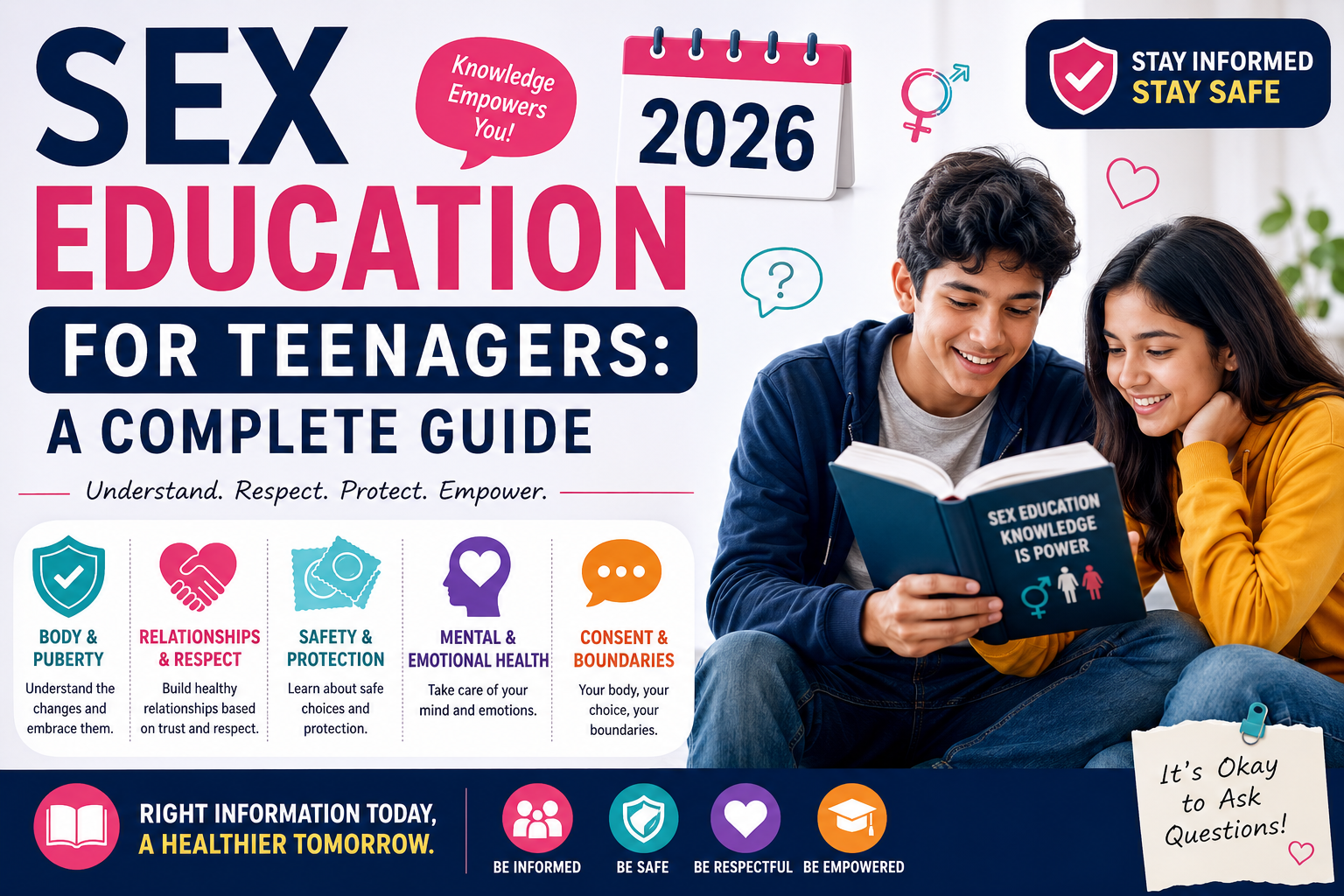
Sex education for teenagers is the structured, age-appropriate teaching of puberty, reproductive health, consent, relationships, and safety that helps young people make informed, responsible decisions. Done well, it protects teenagers from unplanned pregnancy, sexually transmitted infections, and unhealthy relationships — while building confidence, respect, and emotional maturity.
This 2026 guide breaks down everything parents, teachers, healthcare professionals, and teens themselves need to know, using guidance from the World Health Organization (WHO), UNESCO, and other recognized health authorities.
While sex education for teenagers focuses on puberty, reproductive health, consent, and pregnancy prevention, it's also important to understand that some individuals or couples may face infertility later in life. In such cases, assisted reproductive options like surrogacy may be considered under medical guidance. Learn more about Surrogacy Cost in India or explore the Surrogacy Cost in Mumbai to understand the process and expenses involved.
What Is Sex Education?
Sex education is a lifelong process of learning about the physical, emotional, and social aspects of human sexuality. For teenagers, it typically covers:
- Body changes during puberty
- The reproductive system
- Consent and personal boundaries
- Healthy relationships and communication
- Contraception and STI prevention
- Emotional and mental well-being related to sexuality
UNESCO defines this broader approach as Comprehensive Sexuality Education (CSE) — a curriculum-based process of teaching and learning about the cognitive, emotional, physical, and social aspects of sexuality, designed to equip young people with knowledge, skills, attitudes, and values that empower them.
Why Sex Education Is Important for Teenagers
Teenage years bring rapid physical and emotional changes. Without accurate guidance, teens often turn to unreliable sources like social media or peers, leading to confusion, risky behavior, or fear.
Sex education for teenagers matters because it:
- Reduces rates of teenage pregnancy and STIs
- Builds awareness of consent and personal boundaries
- Improves communication skills in relationships
- Encourages body positivity and self-respect
- Helps teens recognize abuse, coercion, or unhealthy dynamics
- Supports mental health during a period of major hormonal change
- Delays early sexual initiation and reduces risk-taking behavior, according to WHO-reviewed research
Research summarized by WHO indicates that comprehensive programs — as opposed to abstinence-only approaches — are associated with delayed sexual debut, increased contraceptive use, and safer decision-making among adolescents who do become sexually active.
Goals of Comprehensive Sex Education
A well-designed comprehensive sex education program aims to:
- Provide medically accurate, age-appropriate information
- Build life skills like decision-making, negotiation, and refusal skills
- Foster respect for diversity, gender equality, and human rights
- Reduce stigma around puberty, menstruation, and reproductive health
- Prevent gender-based violence and exploitation
- Prepare teens for safe, respectful, and responsible relationships
What Topics Are Covered in Sex Education?
A typical sex education guide for adolescents includes:
|
Category |
Topics Covered |
|---|---|
|
Physical Health |
Puberty, reproductive anatomy, menstrual health, hygiene |
|
Relationships |
Consent, communication, respect, healthy vs. unhealthy dynamics |
|
Safety |
Contraception, STI/HIV prevention, pregnancy prevention |
|
Digital Life |
Online safety, sexting risks, digital consent |
|
Emotional Health |
Body image, peer pressure, mental well-being |
|
Social Awareness |
Gender identity, sexual orientation, diversity and respect |
Understanding Puberty: Physical and Emotional Changes
Puberty is the stage when the body matures sexually, usually beginning between ages 8–13 in girls and 9–14 in boys, though timing varies for every individual.
Common physical changes include:
- Growth spurts and weight changes
- Development of body and facial hair
- Voice changes (in boys)
- Breast development and the start of menstruation (in girls)
- Increased oil and sweat production, leading to acne
Common emotional changes include:
- Mood swings due to hormonal shifts
- Growing interest in relationships and identity
- Increased need for privacy and independence
- Heightened sensitivity to peer opinions
Reassuring teens that these changes are normal — and that timing varies widely from person to person — is one of the most important parts of puberty education for teenagers.
Male and Female Reproductive System (Overview)
Understanding basic anatomy helps teens recognize normal function and identify concerns early.
Female reproductive system (overview):
- Ovaries produce eggs and hormones (estrogen, progesterone)
- The uterus supports pregnancy if fertilization occurs
- The menstrual cycle typically repeats every 21–35 days
Male reproductive system (overview):
- Testes produce sperm and testosterone
- Sperm matures and is transported through the reproductive tract
- Puberty triggers increased sperm production capacity
This is general educational information; detailed anatomical or clinical questions should always be directed to a licensed healthcare provider or school health program.
Consent and Personal Boundaries
Consent means a clear, voluntary, and enthusiastic agreement to any physical or romantic interaction — and it can be withdrawn at any time.
Key principles of consent and boundaries that teens should understand:
- Consent must be freely given, not pressured or coerced
- Silence or lack of resistance is not consent
- A person under the influence of alcohol or drugs cannot legally give consent
- Consent for one activity does not imply consent for another
- Everyone has the right to say no without justification
Teaching consent early builds a foundation of respect that carries into adult relationships.
Healthy vs. Unhealthy Relationships
|
Healthy Relationship |
Unhealthy Relationship |
|---|---|
|
Open, honest communication |
Control or manipulation |
|
Mutual respect for boundaries |
Pressure or guilt-tripping |
|
Trust and honesty |
Jealousy, possessiveness |
|
Support for each other's individuality |
Isolation from friends/family |
|
Equal say in decisions |
One-sided decision-making |
Recognizing these differences early helps teenagers avoid or exit unhealthy dynamics before they escalate.
Communication and Respect in Relationships
Strong relationships are built on communication skills such as:
- Actively listening without interrupting
- Expressing feelings using "I" statements
- Respecting a partner's boundaries without pushing back
- Resolving disagreements calmly, without blame
- Checking in regularly about comfort levels
Respect in relationships also means accepting "no" gracefully and not using guilt or pressure to change someone's mind.
Safe Sex and Contraception Basics
For older, sexually active teens, understanding safe sex education basics is essential for preventing pregnancy and infections.
Common contraception methods (for informational awareness only — always consult a healthcare provider):
|
Method |
Type |
Approximate Effectiveness* |
|---|---|---|
|
Condoms (male/female) |
Barrier |
Also reduces STI risk |
|
Birth control pills |
Hormonal |
Requires daily use, prescription only |
|
IUD (intrauterine device) |
Long-acting |
Requires clinical insertion |
|
Implants |
Long-acting hormonal |
Requires clinical insertion |
|
Abstinence |
Behavioral |
100% effective against pregnancy/STIs |
*Effectiveness data varies by source and correct usage; teens should consult a licensed healthcare provider or clinic such as those listed by the CDC or WHO for personalized guidance.
Pregnancy Prevention: What Teenagers Should Know
Key facts about pregnancy prevention every teen should understand:
- Pregnancy can occur the very first time a person has penetrative sex
- No method except abstinence is 100% effective
- Combining condoms with another method significantly lowers risk
- Emergency contraception exists but is not a routine method
- Open conversations with a trusted adult or doctor reduce risky decision-making
Sexually Transmitted Infections (STIs): Causes, Prevention, and Testing
STIs are infections passed through sexual contact, including some spread through skin-to-skin contact, not just fluids.
Common prevention strategies:
- Consistent and correct condom use
- Regular STI testing for sexually active individuals
- Open communication with partners about sexual health history
- HIV prevention through protection and, where prescribed, medical options like PrEP
- Avoiding sexual contact with symptomatic or untested partners
According to CDC data, adolescents and young adults account for a substantial share of new STI diagnoses in the United States each year, making regular testing and open dialogue especially important for this age group.
Menstrual Health and Hygiene
Menstrual health is a normal, healthy part of puberty for people with a uterus. Good hygiene practices include:
- Changing pads/tampons every 4–6 hours
- Washing hands before and after changing products
- Tracking cycle length to notice irregularities
- Seeking medical advice for severe pain, very heavy bleeding, or irregular cycles
- Reducing stigma by normalizing open conversation about periods
Myths vs. Facts About Sex Education
|
Myth |
Fact |
|---|---|
|
Sex education encourages early sexual activity |
Research shows it often delays sexual initiation |
|
You can't get pregnant the first time |
Pregnancy is possible at any time ovulation occurs |
|
STIs always show symptoms |
Many STIs are asymptomatic and only found through testing |
|
Pulling out is a reliable method |
It has a high failure rate compared to other methods |
|
Talking about consent is unnecessary among couples |
Consent should be discussed in every relationship, every time |
Internet Safety, Sexting, and Digital Consent
Digital life adds new risks for teens, including:
- Sexting risks: Images shared can be forwarded without consent and may have legal consequences, even between minors
- Digital consent: Just like physical consent, online interactions require clear agreement before sharing personal content
- Online predators: Teens should avoid sharing personal details with strangers online
- Pornography awareness: Content online often misrepresents real relationships and consent; open, factual conversations help counter misinformation
Parents and schools should encourage teens to report uncomfortable online interactions immediately, without fear of punishment.
Mental and Emotional Well-being
Sexuality and mental health are closely connected. Teens benefit from:
- Understanding that anxiety or confusion about changes is normal
- Learning to manage peer pressure around dating or sexual activity
- Building body positivity instead of comparing themselves to others
- Recognizing warning signs of depression or anxiety and seeking help
- Knowing that self-worth isn't tied to relationship status or sexual activity
LGBTQ+ Awareness and Respect
Sexual orientation and gender identity are recognized by major health organizations, including WHO, as normal variations of human diversity. Age-appropriate education should:
- Present factual information without judgment
- Teach respect for all identities and orientations
- Reduce bullying and stigma in schools
- Provide safe spaces for questions and support
Schools and parents should follow local curriculum standards while ensuring all students feel safe and respected.
Tips for Parents to Talk About Sex Education
Communication with parents is one of the strongest protective factors for teens. Practical tips:
- Start conversations early and keep them ongoing, not a single "talk"
- Use accurate, age-appropriate language
- Stay calm and non-judgmental, even with difficult questions
- Share personal values alongside factual information
- Use everyday moments (TV shows, news) as natural conversation starters
- Reassure teens they can come to you without fear of punishment
Learning about reproductive health helps teenagers make informed choices throughout life. Although most young people will never need fertility treatment, adults who experience infertility may benefit from assisted reproductive technologies such as IVF. Read more about the IVF Cost in Delhi or check the IVF Cost in Ranchi to learn about treatment options and estimated costs.
Tips for Teachers and Schools
Communication with teachers and structured school programs reinforce what teens learn at home. Recommendations:
- Follow national or state curriculum standards for age-appropriateness
- Use inclusive, medically accurate materials
- Create a judgment-free classroom environment
- Train staff regularly on current best practices
- Involve school counselors for sensitive or individual concerns
- Partner with healthcare organizations, such as Vinsfertility, for expert-reviewed reproductive health resources when schools need additional clinical accuracy
Common Mistakes Teenagers Should Avoid
- Relying on social media or friends instead of verified sources for health information
- Ignoring consent conversations because a relationship feels "serious"
- Believing myths about pregnancy or STI prevention
- Sharing private images without fully considering digital consent
- Avoiding STI testing out of fear or embarrassment
- Staying silent about pressure or discomfort in a relationship
Frequently Asked Questions About Sex Education
1. What age should sex education start? Most health authorities, including UNESCO, recommend age-appropriate education starting in early childhood, with more detailed reproductive and relationship content introduced around ages 9–12 and continuing through the teen years.
2. Is sex education only about biology? No. Comprehensive programs also cover consent, relationships, emotional health, digital safety, and communication skills.
3. Does sex education increase teen sexual activity? Research reviewed by WHO shows comprehensive programs are more often associated with delayed sexual initiation and safer behavior, not increased activity.
4. What's the difference between abstinence-only and comprehensive sex education? Abstinence-only programs teach abstinence as the sole option, while comprehensive programs cover abstinence alongside contraception, consent, and relationship skills.
5. How can parents start the conversation with a shy teenager? Start with low-pressure, ongoing conversations rather than one big talk, and use everyday examples like TV shows or news stories as openers.
6. What is menstrual hygiene management? It refers to safe, informed practices around managing periods, including access to clean products, private facilities, and accurate health information.
7. Are condoms enough to prevent pregnancy? Condoms significantly reduce risk but are not 100% effective; combining methods increases protection.
8. Can teenagers get tested for STIs confidentially? In many regions, confidential testing is available through school clinics or public health services; policies vary by location, so teens should check local resources.
9. What should a teen do if they experience pressure in a relationship? They should talk to a trusted adult, counselor, or helpline, and remember that healthy relationships never involve pressure or coercion.
10. How is sexting risky for teenagers? Shared images can be forwarded without consent and, in some regions, may carry legal consequences even among minors.
11. What is digital consent? It's the principle that sharing or requesting personal images or messages online requires clear, voluntary agreement, just like physical consent.
12. How do schools decide what to teach in sex education? Schools generally follow state or national curriculum standards, often informed by public health guidance and community input.
13. Is it normal for puberty timing to vary between individuals? Yes, puberty can begin anywhere between ages 8–14, and variation is completely normal.
14. What resources exist for LGBTQ+ teens seeking support? School counselors, verified health organizations, and local support groups are strong first resources; national helplines can also provide confidential guidance.
15. Where can teens get accurate reproductive health information? Verified sources include school health programs, licensed healthcare providers, and public health organizations like WHO, CDC, or UNESCO.
Expert Tips for Making Safe and Informed Decisions
- Always verify health information through trusted sources, not social media trends
- Talk to a parent, teacher, or counselor before making major decisions
- Remember that saying no is always a valid choice
- Get regular check-ups if sexually active
- Practice open, honest communication in every relationship
Key Takeaways
- Sex education for teenagers covers far more than biology — it includes consent, relationships, emotional health, and digital safety
- Comprehensive programs are linked to delayed sexual initiation and safer decision-making
- Consent must be clear, voluntary, and ongoing in every interaction
- Contraception reduces but doesn't eliminate pregnancy or STI risk — only abstinence is 100% effective
- Open communication with parents and teachers is one of the strongest protective factors for teens
- Reliable information should always come from verified medical or educational sources, such as WHO, UNESCO, CDC, or platforms like Vinsfertility
Conclusion
Sex education for teenagers isn't a single conversation — it's an ongoing process that shapes how young people understand their bodies, relationships, and choices for life. When delivered with accurate information, empathy, and consistency, it protects teens physically and emotionally while building the confidence to make informed decisions.
Parents, teachers, and healthcare providers all play a role in making this education accessible, judgment-free, and medically accurate. For families seeking additional reproductive health guidance, resources from trusted organizations like Vinsfertility can complement school-based programs with expert-reviewed information.
Have questions about reproductive health or adolescent wellness? Reach out to a licensed healthcare provider or your school's health program to continue the conversation in a safe, supportive space.